Retail, CPG & Logistics
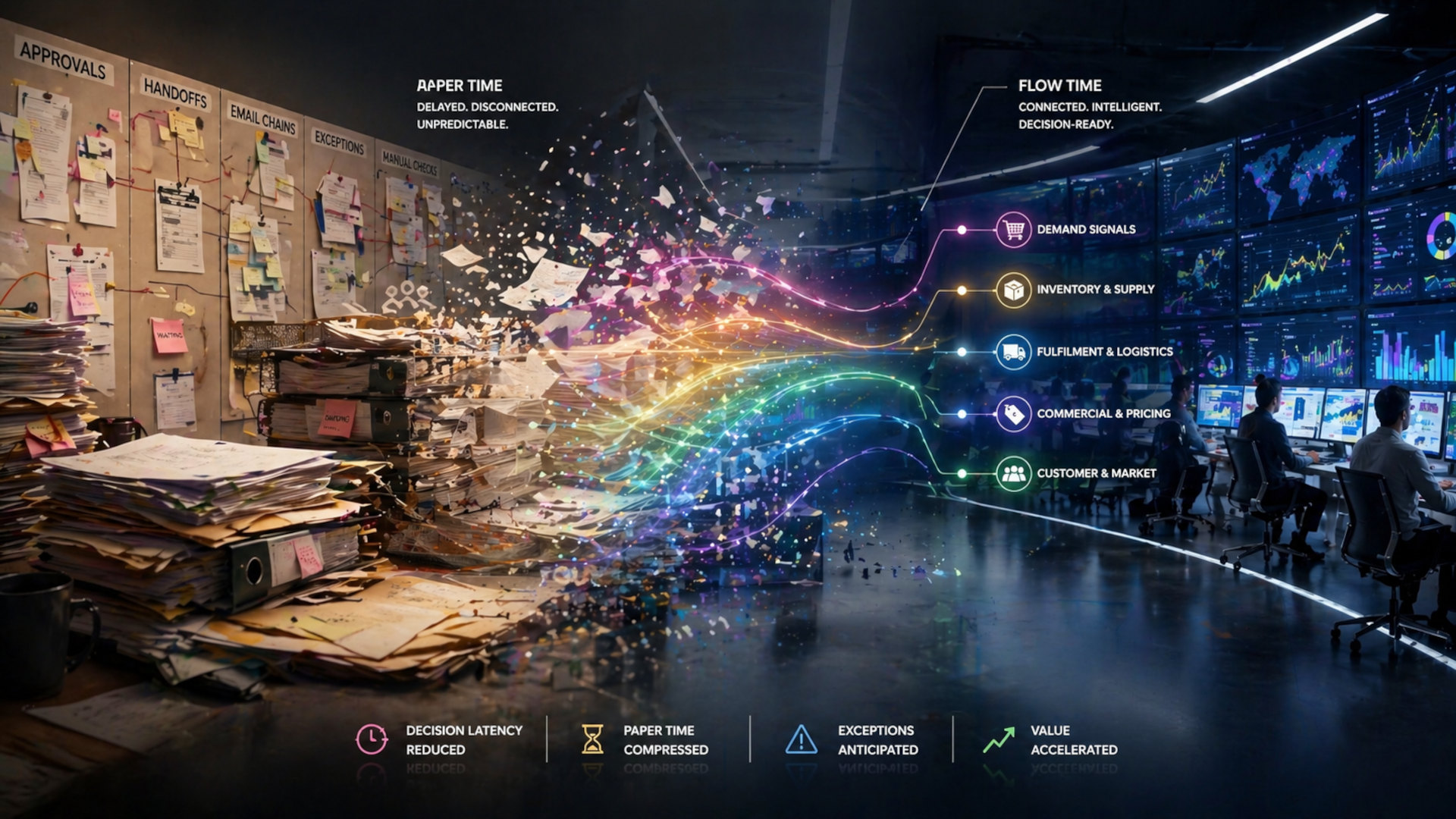
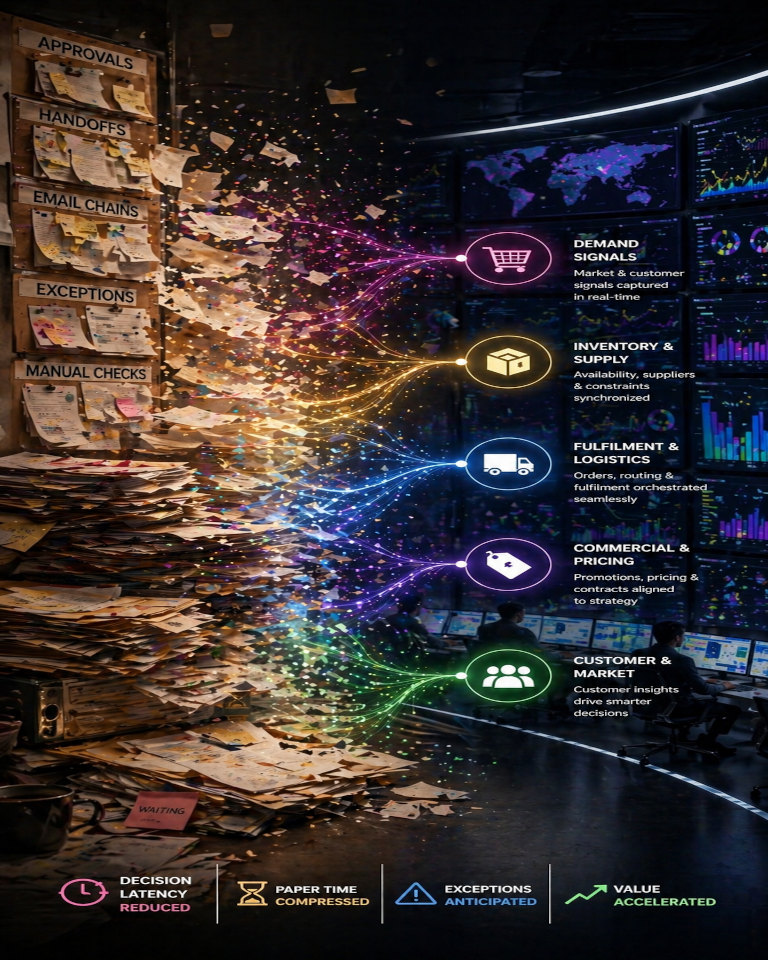
Retail, CPG, and Logistics enterprises are receiving more signals, faster, than ever before – from demand shifts, inventory exceptions, supplier disruptions, pricing opportunities, and customer behaviour. The data exists. The AI tools exist. The ambition exists.
What doesn’t exist, in most enterprises, is an operating model designed to act on those signals at the speed they arrive.
Demand exceptions sit in email chains waiting for a manager’s approval. Promotional allocation decisions move through three-week review cycles. Backorder resolutions depend on whoever picks up the phone. Pricing decisions require cross-functional sign-off that takes longer than the window that created the opportunity.
This is the paper time problem – and in Retail, CPG, and Logistics, it is especially acute because the velocity of the market has already outpaced the velocity of enterprise decision-making. AI cannot close that gap by sitting on top of the existing structure. The structure itself must be redesigned.
Flow Cracker partners with Retail, CPG, and Logistics leaders to:
- Redesign the operating model so AI can act on demand, supply, and fulfilment signals within defined authority – not just flag them for human review
- Encode the decision logic of high-frequency workflows – promotions, exceptions, allocation, pricing – so AI has explicit thresholds, evidence requirements, and escalation paths
- Compress the paper time layer across your core value streams, where coordination and approval overhead concentrates
- Build AI maturity that advances systematically – through the Generative Flow Framework – from AI-Assisted through to AI-Native operation
Flow Cracker in Action
Flow Cracker’s reWire track redesigns the operating model that AI must land into across Retail, CPG, and Logistics enterprises. That means mapping how value actually flows – from demand signal to fulfilment, from product idea to shelf, from supplier exception to resolution – and making the decision logic of each flow structurally explicit. Who decides, on what evidence, at what threshold, and where AI acts versus where humans govern. This is the foundation that makes AI-Native operation possible at enterprise scale, not just at team level.

The highest concentration of AI-compressible delay in Retail, CPG, and Logistics sits in the decision layer of demand-to-fulfilment flows. Backorder resolution. Allocation exceptions. Supplier disruption responses. Inventory disposition decisions. Each of these is a high-frequency decision cluster where the logic is known – but not encoded. Flow Cracker designs the decision architecture across these flows: making triggers explicit, evidence requirements structured, thresholds defined, and escalation paths pre-built – so AI can act within governed authority rather than waiting for a human to pick up the signal.
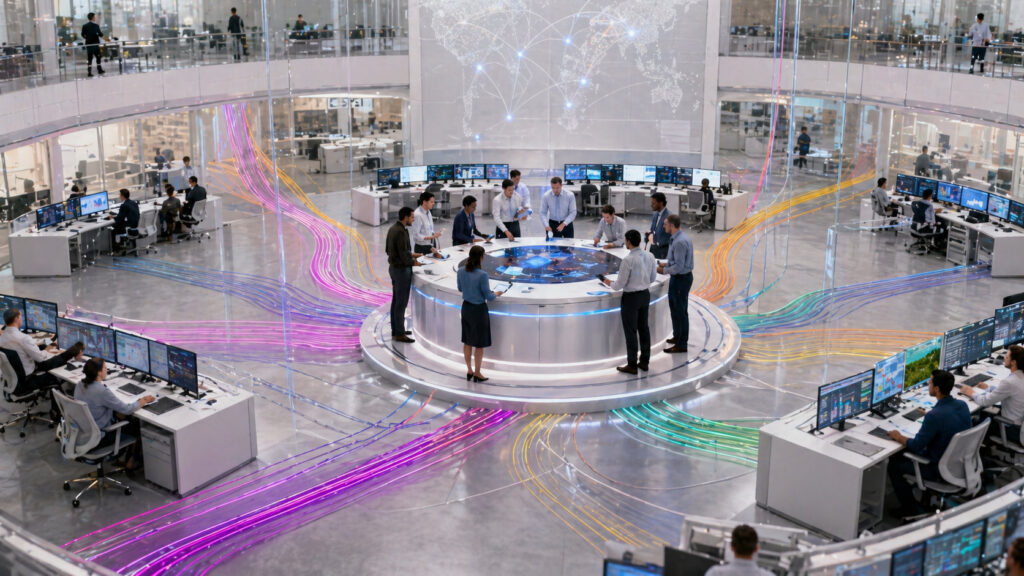
Flow Cracker’s reScale track deploys AI into the operating model structure that reWire has created – matching every deployment to its target operating model horizon state. In Retail, CPG, and Logistics, this means AI that acts on demand signals, pricing windows, and fulfilment exceptions within defined authority – not AI that produces recommendations that sit in a dashboard waiting for manual action. Structure before stack. The knowledge fabric, the context engineering, and the agent orchestration all anchor to the operating model – so deployments scale beyond the pilot.

Promotional planning, pricing decisions, and go-to-market execution are among the highest-volume decision flows in Retail and CPG – and among the most paper-time-intensive. Approval chains for promotional mechanics. Pricing escalation loops. Campaign launch sign-offs. Each of these is a compressible workflow where encoded decision logic, structured evidence, and governed AI participation can dramatically reduce cycle time. Flow Cracker maps the paper time layer in your commercial value streams and designs the operating model changes that allow AI to act on commercial signals at the speed the market requires.

AI-Native transition in Retail, CPG, and Logistics changes what people do at every level of the enterprise. Category managers shift from routine exception handling to governing the AI systems that handle it. Supply chain planners shift from coordination work to judgment work on novel situations. Commercial leaders shift from approving decisions to designing the decision logic that AI operates within. Flow Cracker’s reOrient track evolves workforce capabilities and leadership operating models in step with the rewired enterprise – so the human layer and the AI layer evolve together, not in conflict.